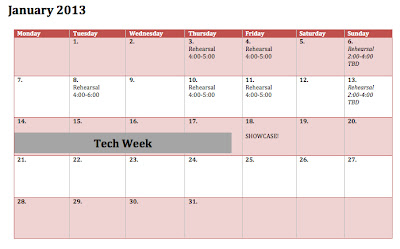
November 6th - IP Calendar Due November 10th - Finish reading The Tempest November 11th - Finish watching The Tempest November 12th - Have a scene picked from The Tempest November 13th - Talk to Leila November 15th - Create a rehearsal calendar and give it to Leila November 26th - IP Journal Due November 27th - Have the piece choreographed December 3rd - Begin rehearsing with Leila December 7th - IP Journal Due January 3rd - IP Individual Meetings January 7th - IP Individual Meetings January 8th - Have the piece finished January 10th - IP Production Meeting January 14th-18th - IP Tech Week January 18th - IP Showcase
*The ability to interpret something. How we frame something in theatre to allow the audience to look for meaning within it.*
1. Raw Materials (devising)
2. Shaping (performance concept)
Friday, September 7, 2012
Practice: Kathakali Theatre Play: The Progency of Krishna by Mandavappalli Ittiraricha Menon Aspects of Practice:
Based on themes from Hindu mythology (the Ramayana and the Mahabharata).
Elaborate make up code.
A highly developed language of gesture, through which the artist can convey whole sentences and stories.
Included five elements of "fine arts": natyam (expression), nrithyam (dance), mudras (enactment), geetha (song) and vadyam (instrumental accompaniment).
"The training and body language were influenced by the techniques of Kalarippayattu (a martial art)".
Royal Patronage.
Characters are classified into five groups (Pacha, Kathi, Thadi, Kari and Minukku)
The make up is different depending on the group.
Categorized according to their nature.
18 additional characters who have distinct make up.
The dancers wear large head dresses.
The style of singing is called Sopaanam.
The orchestra provides the background to the dancing and serves as a highly expressive special effects team.
Aspects of Play:
Hindu Mythology
Royal Patronage
Character Classification (nature, make up etc.)
Possible Focus:
Hindi Mythology (Scenes 6-11)
Royal Patronage (Scene 1)
Possible Research Question:
How is Hindi Mythology used to create a more relatable and understandable circumstance in Scenes 9-11 of The Progency of Krishna by Mandavappalli Ittiraricha Menon?
Based on themes from Hindu mythology (the Ramayana and the Mahabharata).
Elaborate make up code.
A highly developed language of gesture, through which the artist can convey whole sentences and stories.
Included five elements of "fine arts": natyam (expression), nrithyam (dance), mudras (enactment), geetha (song) and vadyam (instrumental accompaniment).
"The training and body language were influenced by the techniques of Kalarippayattu (a martial art)".
Ramanattam is divided into 8 sections and is performed within 8 days.
Royal Patronage.
Characters are classified into five groups.
The make up is different depending on the group.
Categorized according to their nature.
The classifications are Pacha, Kathi, Thadi, Kari and Minukku.
18 additional characters who have distinct make up.
The dancers wear large head dresses.
Contours of the face are extended with moulded lime.
The style of singing is called Sopaanam.
The orchestra provides the background to the dancing and serves as a highly expressive special effects team.